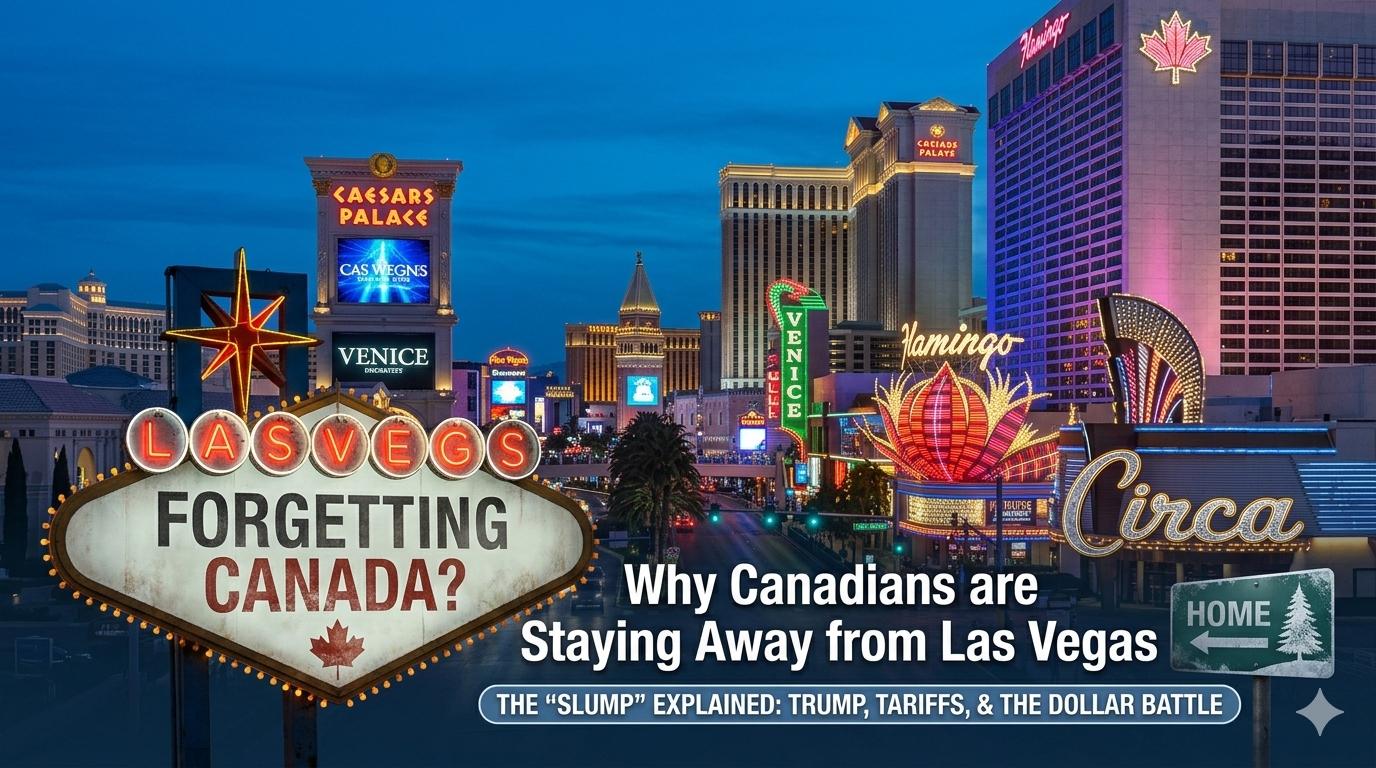
For decades, the relationship between Canadian travellers and Las Vegas was as solid as a winning streak at a blackjack table. Historically, Canada has been the single largest source of international tourism for Sin City. Sun-seeking Canadians regularly flocked to the desert to escape brutal winters, pumping billions of dollars into the Nevada economy.
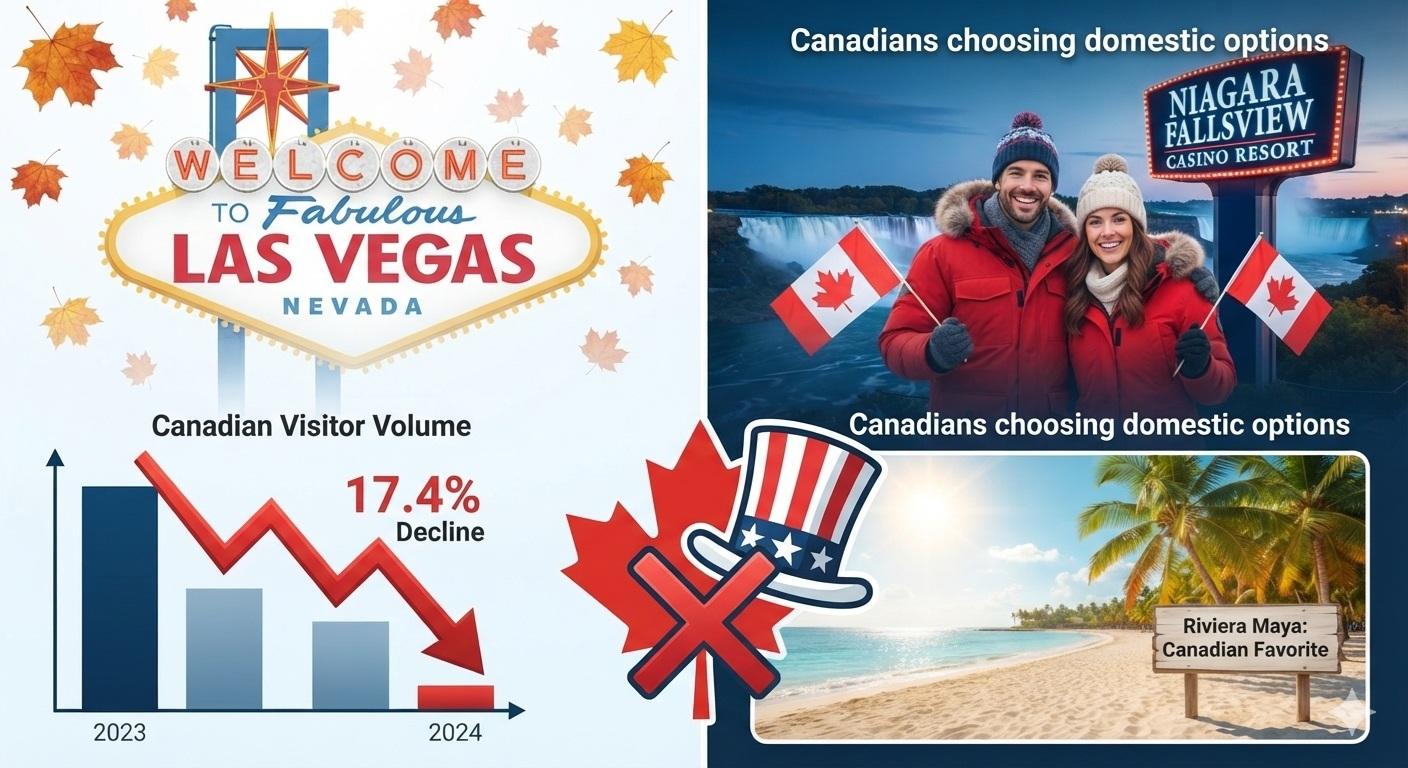
However, recent data reveals a massive shift in travel behaviour. According to the Las Vegas Convention and Visitors Authority (LVCVA), Canadian visitation to Las Vegas plummeted by 17.4% in 2025, translating to over 250,000 fewer visitors. This decline represents the sharpest non-pandemic tourism drop for the city since record-keeping began in 1970.
Why Canadians Are Staying Away from Las Vegas
So, what is driving this unprecedented boycott? The “Sin City Slump” is the result of a perfect storm: intense geopolitical tensions, aggressive trade wars, punishing exchange rates, and a growing domestic backlash against the soaring cost of a Las Vegas vacation.
1. The “Trump Slump”: Geopolitical Tensions and National Pride
The primary catalyst for the sharp drop in Canadian tourism is political. Following U.S. President Donald Trump’s return to the White House, bilateral relations between the two close neighbors hit a historic low. A series of aggressive trade moves and controversial rhetoric severely alienated the Canadian public.
The 51st State Rhetoric
Public sentiment shifted dramatically after President Trump publicly suggested that the U.S. could annex Canada, referring to it as a potential “51st state”. Following these remarks, the Canadian government openly discouraged citizens from vacationing south of the border, sparking an informal but highly effective grassroots travel boycott.
A Matter of Respect
For many Canadian travelers, choosing to stay away from the U.S. is a matter of national pride.
“We’re just so upset with Trump’s total lack of respect, the way he’s been treating Canada,” noted Martyn Daly, a resident of Winnipeg who canceled his annual trip, in an interview with CBC News. “Not going to Vegas is just our small way of saying, ‘We’re not going to take it.'”
This collective emotional response has dramatically shifted flight patterns. Recent flight data shows that Canadian passenger volumes at Harry Reid International Airport have tanked:
- Flair Airlines passenger numbers dropped by a staggering 62%.
- Air Canada reduced its passenger traffic to Vegas by 33%.
- WestJet, historically the largest Canadian carrier into Las Vegas, saw a 31% decline.
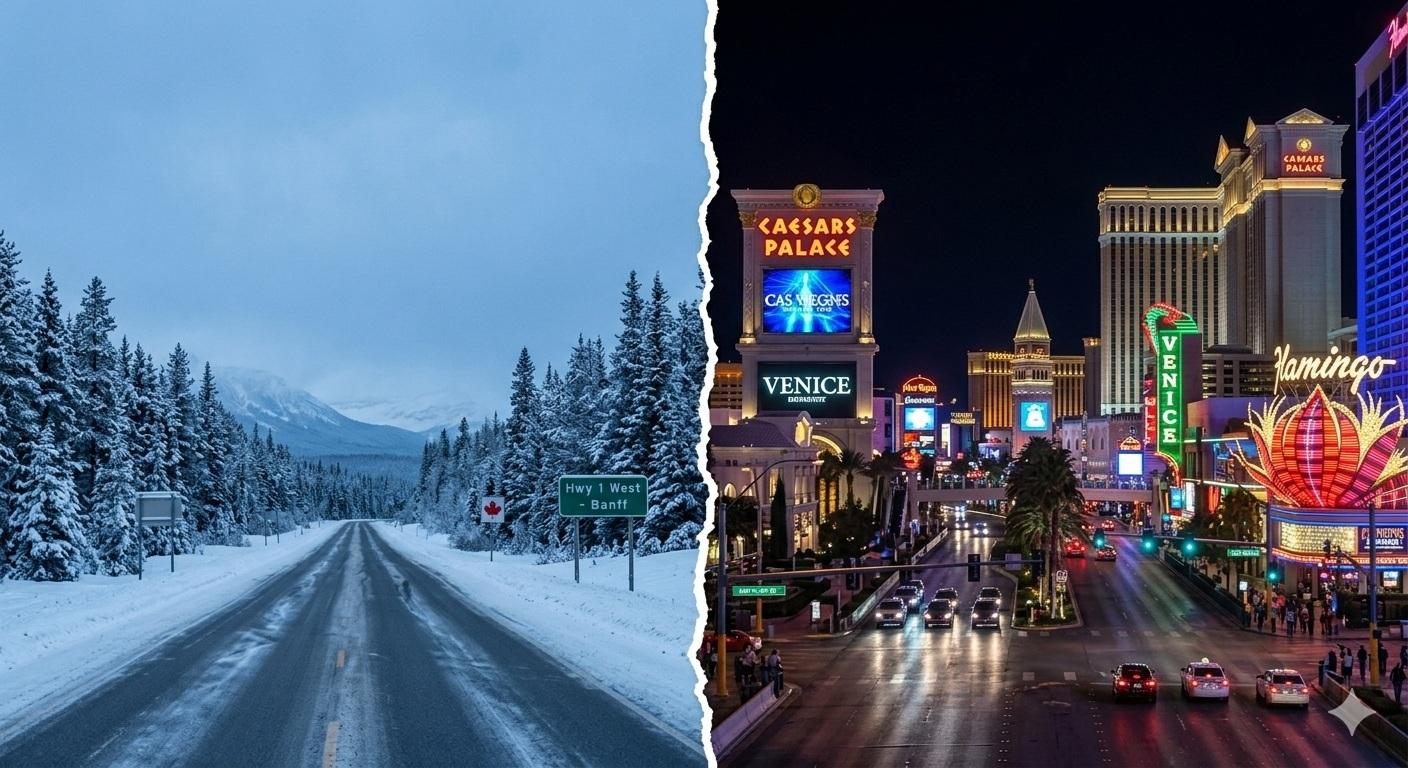
Las Vegas or Canada – Your Choice
2. The Economic Friction: Tariffs and the Weak Canadian Dollar
Beyond political frustration, travelling south has simply become too expensive for the average Canadian household due to macroeconomic shifts. The value of the Canadian Dollar (CAD) against the U.S. Dollar (USD) remains incredibly weak, hovering around $0.72 USD for every $1 CAD.
The Canadian Tourism Slump by the Numbers
2025 Canadian Visitor Drop | Down 17.4% (~250,000 people)
Overall U.S. Travel Drop | Down 29% compared to 2024
Lost to the U.S. Economy | $4.5 Billion USD
Impact on Las Vegas Economy | $3.6 Billion USD / 43,000 jobs
(Sources: Statistics Canada, U.S. Travel Association, and CBER at UNLV)
| Expense Category | Price in USD | Estimated Cost in CAD (approx. 1.38x exchange) |
|---|---|---|
| Mid-Tier Hotel Room | $180 / night | ~$248 CAD/night |
| Strip Dinner for Two | $150 | ~$207 CAD |
| High-End Concert Ticket | $250 | ~$345 CAD |
| Daily Resort Fee | $45 / day | ~$62 CAD/day |
The Trade War and Tariffs
The administration’s sweeping tariffs on Canadian goods triggered an aggressive economic conflict. As these tariffs impacted businesses north of the border, Canadian consumer confidence fell, prompting many families to tighten their leisure travel budgets or spend their money closer to home.
The CAD to USD Exchange Rate
The purchasing power of the Canadian dollar (CAD) relative to the U.S. dollar (USD) has remained incredibly weak. Hovering around $0.72 to $0.73 USD, Canadians immediately face an automatic 27% penalty on every dollar spent before they even leave home. When converting funds for gambling, dining, and hotel stays, the exchange rate makes a trip to Nevada highly cost-prohibitive.
3. Post-COVID Price Gouging and Fee Fatigue
While politics and exchange rates provide the initial push, Las Vegas’s own pricing strategies are keeping visitors away. Online travel forums, including Reddit’s r/vegas community, feature extensive complaints from frequent travellers regarding the loss of value on the Las Vegas Strip.
- Skyrocketing Base Costs: The era of cheap mid-week rooms and affordable dining on the Strip is gone. Travellers now routinely face $40 USD hamburgers and basic hotel rooms that run upwards of $400 USD a night during peak times.
- Hidden Fee Fatigue: Resort fees—which can add an extra $40 to $50 USD per night plus tax—are deeply unpopular. Combined with the introduction of paid parking at almost all major Strip properties, travellers feel nickel-and-dimed at every turn.
- Decreasing Gambling Value: Changes to casino rules, such as the widespread adoption of 6:5 payouts on blackjack (down from the traditional 3:2) and triple-zero roulette wheels, have made gambling less favourable for players looking to stretch their bankrolls.
4. The Local Fallout: Empty Rooms and Political Impact
The absence of Canadian tourists is dealing a heavy blow to the Southern Nevada economy. Stephen Miller, an economics professor at the University of Nevada, Las Vegas (UNLV), noted that Canadian visitors historically contributed $3.6 billion USD annually to the local economy, directly supporting roughly 43,000 hospitality and service jobs.
Canadian Tourism Contributions (Las Vegas)
$3.6 Billion USD Annual Spending –> Supports 43,000 Local Jobs
The resulting economic drop has transformed the tourism slump into a major political talking point. In Nevada, a critical battleground state, local representatives have highlighted the empty hotel rooms and reduced working hours for hospitality union members as a direct consequence of current federal trade policies. CEOs from major gaming corporations, including MGM Resorts International and Caesars Entertainment, have openly noted the significant drop in international room nights during their quarterly earnings calls.
5. Fighting Back: The “Vegas At Par” Strategy
Desperate to reverse this trend, select casino operators are taking aggressive steps to welcome Canadians back.
The Downtown Currency Promotion
Derek Stevens, owner of downtown properties like the Circa Resort & Casino, The D Las Vegas, and the historic Golden Gate Hotel & Casino, launched a “Vegas At Par” marketing campaign. This promotion accepts the Canadian dollar at a 1:1 ratio for hotel rooms, select bars, and matches slot/table play. By absorbing the 27% currency disparity, these properties successfully drew over 15,000 Canadian check-ins within the initial months of the program.
The “at par” Value Proposition
Standard Exchange Rate: $500 CAD –> $365 USD (Loss of ~27%)
Downtown “At Par” Promos: $500 CAD –> $500 USD Value
Wholesale Travel Discounts
Major travel providers are joining the push to regain market share. Air Canada’s vacation division introduced bundle discounts offering up to 35% off flight-and-hotel packages across 35 different Las Vegas properties. Simultaneously, the LVCVA has launched aggressive sales missions across Western Canada to reassure travellers that their business is highly valued.
Conclusion: Will Canadians Return to the Strip?
The current slump shows that international travel trends are deeply tied to the political climate and economic respect. While “at par” promotions offer great value for budget-conscious travellers heading downtown, a widespread return to the Las Vegas Strip hinges on a broader cooling of trade tensions and an improvement in the value of the Canadian dollar.
Until then, many Canadians are choosing to keep their travel dollars at home, exploring domestic resorts or opting for international destinations where they feel their presence, and their currency, goes further.